Meet the Government Job Nobody Budgeted For: State Digital Accessibility Officer
Three years ago, almost nobody held this title. NASCIO just published a national portrait of the states that created it, and the gap between the states that have and the states that haven't.
Every state has an accessibility policy by now, more or less. Fewer have anyone whose actual job is making sure the policy means something day to day. NASCIO calls that person a Digital Accessibility Officer. A growing number of states are starting to hire for it.
1Before: Policy With No Owner
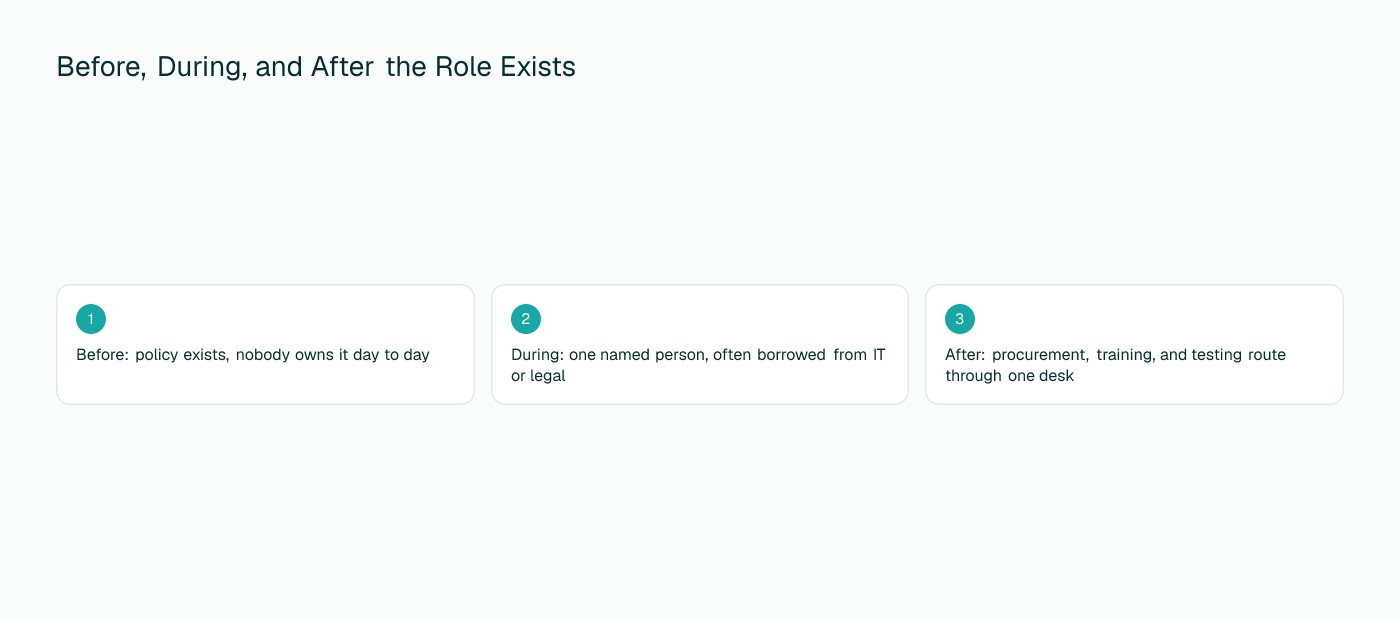
71% of states report full or near-full compliance on statewide accessibility policy. That number sounds like good news until you look at what it's actually measuring: a document exists and leadership signed it. It says nothing about whether anyone wakes up each morning responsible for keeping sites compliant.
In most agencies before this role existed, accessibility ownership sat wherever it landed. Sometimes IT. Sometimes legal. Sometimes the web manager, by default, because they're the one who gets the angry email. Nobody owned the whole picture. Everybody owned a slice.
2What NASCIO Actually Studied to Write This
This isn't a survey NASCIO ran once and summarized in a press release. The IT Accessibility Working Group behind it ran nine months of sessions, pulling in state CIOs, sitting accessibility officers, and legal staff to compare notes on what was actually working. The resulting series covers policy development, procurement integration, remediation planning, training, and testing, which is the same scope the role itself ends up owning once it exists.
That depth is why the finding is worth more than a typical trend piece. States weren't asked to guess at best practice. They were asked what they'd actually built, and the consistent answer across very differently sized states was one named person, not a committee.
3During: One Name, Often Borrowed From Somewhere Else
NASCIO's portrait of the role describes states putting one named person in charge, and it's rarely a clean, fully-funded new hire. More often it's someone pulled partway out of IT, or legal, or the ADA coordinator role that already existed, now carrying a formal title and a wider mandate than the old job had.
That person's real job, once named, tends to cover four things: setting policy that actually gets enforced, building accessibility into procurement language before a vendor contract gets signed, running or commissioning staff training, and owning the testing and QA pipeline instead of leaving it to whoever happens to notice a broken page.
4The Four Responsibilities, One at a Time
Policy
Not drafting a document once. Reviewing it annually and making sure new hires actually read it, since a policy nobody reads protects nobody.
Procurement
Catching a missing accessibility clause before a contract gets signed, not after a vendor ships something that fails.
Training
Running or commissioning sessions for the specific people who touch content: editors, developers, procurement staff, not a single annual all-hands that nobody remembers by March.
Testing and QA
Owning the scanning cadence and the remediation log end to end, so a complaint finds a program instead of a filing cabinet.
5After: Procurement and Training Route Through One Desk
States past this transition show up differently in the data. 66% report full or near-full compliance on procurement requirements specifically, meaning accessibility language is actually written into RFPs and vendor contracts, not just general policy. That gap between 71% policy compliance and 66% procurement compliance is close, which tells you something: once a state names an owner, the owner's job naturally pulls procurement and training into the same loop, backed by a free audit tool instead of a manual review.
No Budget for a New Hire? Start With the Charter.
Our role charter template lays out exactly what this job owns, so you can assign it to an existing title instead of waiting on a new line item.
Get the Role Charter Template6States That Got There First
NASCIO's portrait notes a pattern among the earliest adopters: the role tends to land inside existing IT governance rather than as a standalone office, reporting to a state CIO or deputy CIO rather than sitting three levels removed with no real authority. States that waited to build a brand new department around the title generally moved slower than states that simply handed the four responsibilities to someone already inside the chain of command.
7What If Your Agency Can't Fund a Dedicated Hire?
Most agencies reading this don't have a line item open for a new title. That's fine. NASCIO's own guidance doesn't say every state needs a brand new position. It says every state needs a named owner. Assign the four responsibilities above to an existing role, your ADA web coordinator, your IT director, whoever already touches the most of this work, and put it in writing. A platform that enforces accessibility rules at the publishing layer also takes pressure off whoever carries this title, since fewer violations ever make it live for them to chase down.
8What Good Looks Like a Year In
A year after naming an owner, a state or agency that did this right can answer four questions without looking anything up: who owns the policy, what it says, when procurement last blocked a non-compliant vendor, and how many items sit in the remediation backlog right now. An agency that still can't answer those four questions a year later didn't name an owner. It named a title.
Final Takeaway
Policy without an owner is a document. An owner without a platform is a bottleneck. States getting this right are closing both gaps at once, and the data shows which one usually moves first.