States Say They're Compliant. Counties and Small Cities Tell a Different Story.
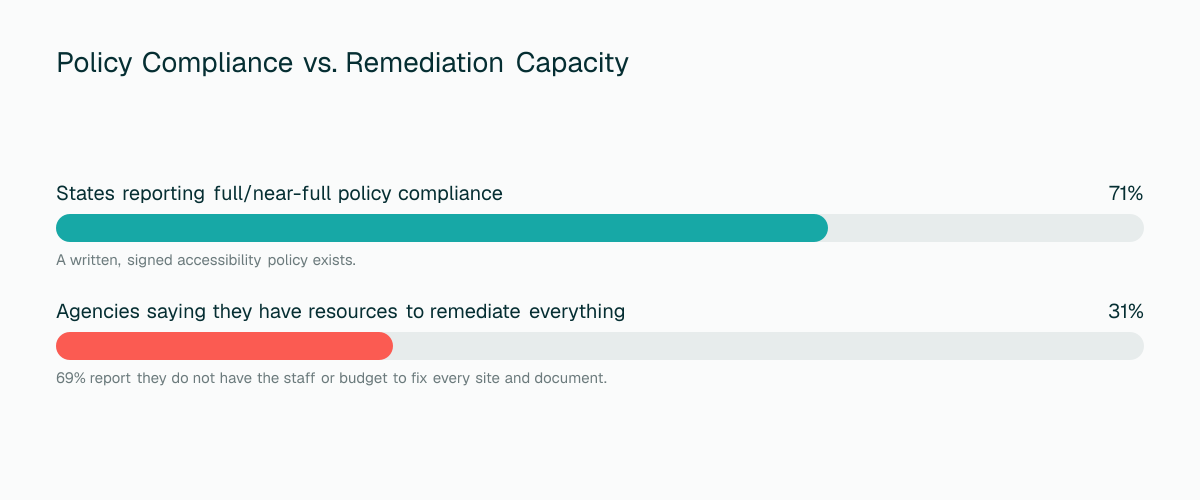
71% of states report full or near-full compliance on accessibility policy. That number describes a document, not the thousands of individual city, county, and district websites sitting underneath it.
Reporting from state digital accessibility officers this year reads as good news on the surface. Most states say they're mostly compliant. Read the next line of the same survey and the story changes: most of those same respondents also say they don't have the staff or budget to remediate everything they're responsible for.
1The Problem: Policy Compliance Isn't Site Compliance
A state reporting policy compliance means a written accessibility policy exists, got signed off, and sits in a binder somewhere getting reviewed on schedule. That's a real thing, and it matters. It's also a single document covering one state agency, not the city websites, county portals, school district sites, and special districts that make up the overwhelming majority of state and local government web presence under Title II.
Those smaller entities, cities and counties under 50,000 population, school districts, water boards, transit authorities, get until April 26, 2028 to comply. A full year longer than the larger jurisdictions. That extra year sounds like a cushion. It's also exactly the group with the least staff to use it.
2The Cause: Capacity Doesn't Scale Down With Population
A state IT department fielding an accessibility program has staff dedicated to it, at least one person, sometimes a small team. A township of 8,000 people has a part-time web manager who also handles the newsletter, the permit portal, and whatever the mayor's office needs by Friday. The compliance obligation is identical. The staffing behind it is not.
That's why 69% of agencies surveyed say they lack the resources to remediate everything they're on the hook for. It's not a failure of will. It's arithmetic. One person covering five jobs doesn't get a sixth job done just because a federal deadline says it matters.
3Why the 2028 Deadline Doesn't Help as Much as It Sounds
A full extra year reads as generous on paper. In practice, a one-person web team spends most of that year on everything else the job already demanded, the newsletter, the permit portal, the public records requests, the website redesign nobody budgeted properly. The deadline doesn't get easier to hit just because it arrives later. It gets easier to forget about until it's close, which is exactly the pattern that turned the April 2027 deadline into a scramble for a lot of larger jurisdictions.
There's a second problem hiding in the extra year. Smaller entities often assume the longer runway means less scrutiny, since enforcement attention has understandably focused on the larger jurisdictions hitting the earlier date first. That assumption doesn't hold once the Michigan Alliance for Special Education-style volume campaigns we've covered elsewhere start running the same scan against smaller sites. A complaint doesn't check your population before deciding whether to file.
4What This Looks Like Up Close
We've worked with agencies exactly this size. A small township running its entire web presence for under a hundred dollars a month, with no dedicated IT staff at all, still has to hit the same WCAG 2.1 AA bar as a state capital. The deadline doesn't ask how big your team is before it applies.
5The Specific Failures That Show Up at This Scale
A small township's accessibility gaps don't look like a county's. They're simpler to describe and, often, simpler to fix once someone actually looks.
- A single-person CMS install with no structured content types, so every fix is manual, page by page.
- A decade of scanned meeting minutes with no text layer, uploaded faster than anyone can tag them by hand.
- No accessibility statement at all, because nobody on a team this size has had the hour it takes to write one.
6The Fix: Platforms That Don't Need a Dedicated Team
The agencies closing this gap aren't hiring their way out of it. Most can't. They're moving to a government CMS that enforces accessibility rulesat the point of publishing, alt text required before an image goes live, contrast locked to an approved palette, PDF uploads scanned automatically, so a one-person web team isn't also an accessibility QA team. The compliance burden moves from a person's daily to-do list into the software itself.
7What a Shared-Services Model Looks Like
Some counties have started offering accessibility scanning and remediation support as a shared service to the small cities and townships inside their borders, the same way regional dispatch or shared IT support already works in a lot of places. It's a practical answer to the arithmetic problem above: one trained person supporting ten small sites gets more done than ten part-time web managers each learning WCAG from scratch on their own time. If your county doesn't offer this yet, it's worth asking whether it should.
Final Takeaway
A statewide policy number is a useful headline and a poor predictor of what a resident experiences on their own city's website. If your agency is the one-person-web-team kind, the extra year to 2028 matters less than what tool you spend it on. See how a special district with a lean team launched compliant without adding headcount, or how a small city went live in 11 days.
Built for Teams Without a Dedicated Accessibility Hire
WPPersona enforces accessibility rules at the platform level, so a one-person web team isn't also responsible for catching every violation by hand.
See Pricing for Small Teams8A Realistic Plan If You're a Team of One
Start with the PDFs, since they're almost always the largest single chunk of risk and the slowest to fix by hand. Run a free scan to find out the real number before guessing at it. Fix the highest-traffic documents first, the forms and notices residents actually need, not the oldest files sitting furthest back in the archive. Write the one-page accessibility statement the same week, since it takes an hour and closes one of the most commonly cited gaps on its own. None of this requires a new hire. It requires picking the right order.