A Complaint Doesn't Investigate One Page. It Investigates Your Whole Site.
A resident reports one broken form. Investigators ask for your policy, your training records, and your entire remediation history. Most web teams find out the gap exists the hard way.
Ask a web manager what happens when someone files an ADA complaint, and most describe a narrow fix. Someone reports a broken page, IT patches the page, done. That's not how it works. And only about half of states have a formal process in place for when it doesn't.
1The Myth: One Complaint, One Fix
The assumption runs like this: a resident can't use a permit form, they email or call, IT fixes the form, the complaint closes. Tidy. Contained. Done by Friday. A lot of agencies operate their entire accessibility response around this assumption, because it's the only version of a complaint most web teams have actually handled.
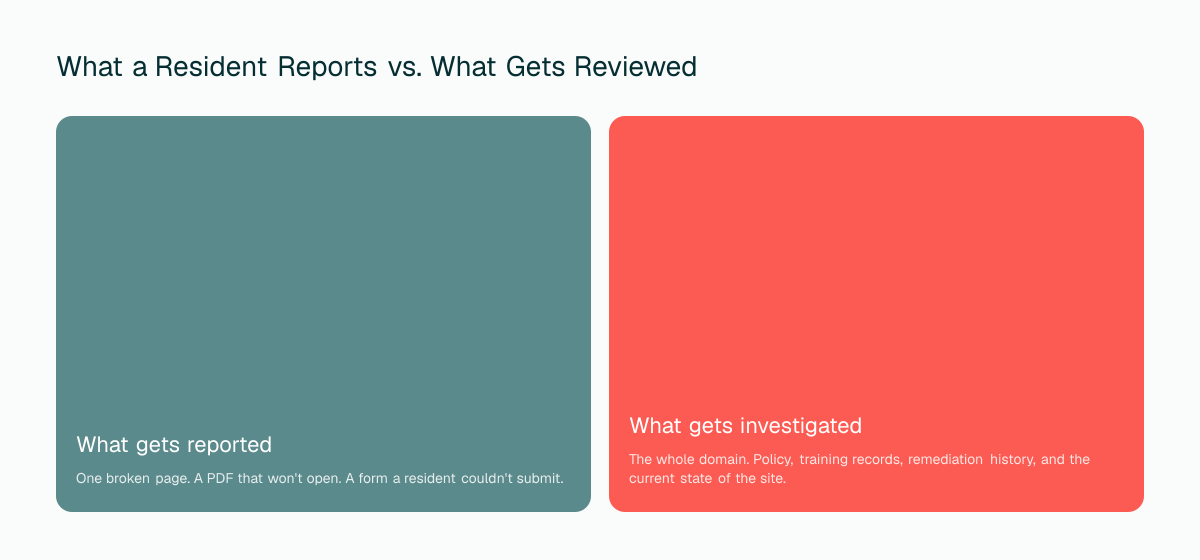
2The Reality: Scope Expands the Moment It's Formal
A formal complaint filed with the Department of Justice or an agency's Office for Civil Rights doesn't stay narrow. Once an investigator decides a complaint has merit, the review covers the domain, not the page. That typically means a request for your written accessibility policy, staff training records, a history of what's already been remediated and when, and the current state of the site as a whole.
Here's the detail that catches teams off guard. The investigator isn't just checking whether the reported form works now. They're checking whether your agency has a functioning accessibility program at all. A single fixed form with no policy behind it, no training record, no remediation log, reads as luck, not compliance.
3What Investigators Actually Request, Document by Document
A records request letter tends to follow the same checklist across agencies, because the questions an investigator needs answered don't change much case to case.
- Your written accessibility policy and the date it was last reviewed.
- Staff training records naming who was trained, on what, and when.
- Any prior scans or audits run against the site, and what came of the findings.
- Your published accessibility statement and feedback mechanism, tested for whether it actually works.
4Why Half of States Are Caught Flat-Footed
A recent survey of state accessibility officers found only about half of states have a formal complaint investigation process at the state or agency level. Another chunk run something informal or ad hoc. The rest have nothing written down at all. If your own agency sits in that last group, the first time you'll build a process is while an investigator is already waiting on your response, which is the worst possible time to design one.
5How Long an Investigation Actually Takes
There's no fixed clock, and anyone who tells you a hard number is guessing. A straightforward case with a cooperative agency and clean documentation can wrap in a few months. A case where records don't exist yet, or where the first response is thin, routinely stretches past a year once follow-up requests and a resolution agreement's own monitoring period get added on. The single biggest lever an agency controls over that timeline is how complete the first response is. A thin first answer buys you a second records request, not a faster close.
6DOJ Complaint vs. OCR Complaint: The Difference That Matters
The two paths aren't identical, even though both enforce the same WCAG 2.1 AA standard. A complaint to the Department of Justice typically comes through its Disability Rights Section and can target any Title II entity directly: a city, a county, a special district. A complaint to a federal agency's Office for Civil Rights usually applies where that agency funds the entity, which is why HHS-funded health departments and Education Department-funded school districts tend to see OCR specifically rather than DOJ. The paperwork differs slightly. The underlying expectation, a working accessibility program with evidence behind it, does not.
Build the File Before You Need It
Our DOJ complaint response playbook lists exactly what an investigator asks for in the first 10 days, so your policy, training records, and remediation log already exist when the letter arrives.
Get the Complaint Response Playbook7The Action: Three Things Before a Complaint Ever Lands
Write the policy down
A one-page written accessibility policy, dated and reviewed annually, is the single document investigators ask for first. If it doesn't exist, that's the finding, before they even test a page.
Keep a remediation log
A simple spreadsheet works: what was found, what was fixed, when, by whom. A platform built around accessibility keeps this log automatically instead of relying on someone remembering to update a sheet.
Name a point of contact
Your accessibility statement needs a real name and a real way to reach them. An investigator checking for good faith looks for this first.
See how WPPersona's government CMS tracks all three automatically.
8What a Clean File Looks Like When the Letter Arrives
Picture the agency that actually has this together. The records request lands on a Tuesday. By Thursday, the ADA coordinator has pulled a policy last reviewed four months ago, a training log with four sessions this year, a remediation log showing thirty-one fixes with dates, and a feedback form that routes to a monitored inbox. None of that stops an investigation from happening. It changes what the investigation finds, and it's the difference between a case that closes in ninety days and one that drags into a multi-year monitoring period, the way a mid-size city resolved its own DOJ complaint.
Final Takeaway
Fixing the reported page was never the hard part. Having a program behind it is. Build the policy, the log, and the named contact before a resident ever files the complaint that tests whether you have one.