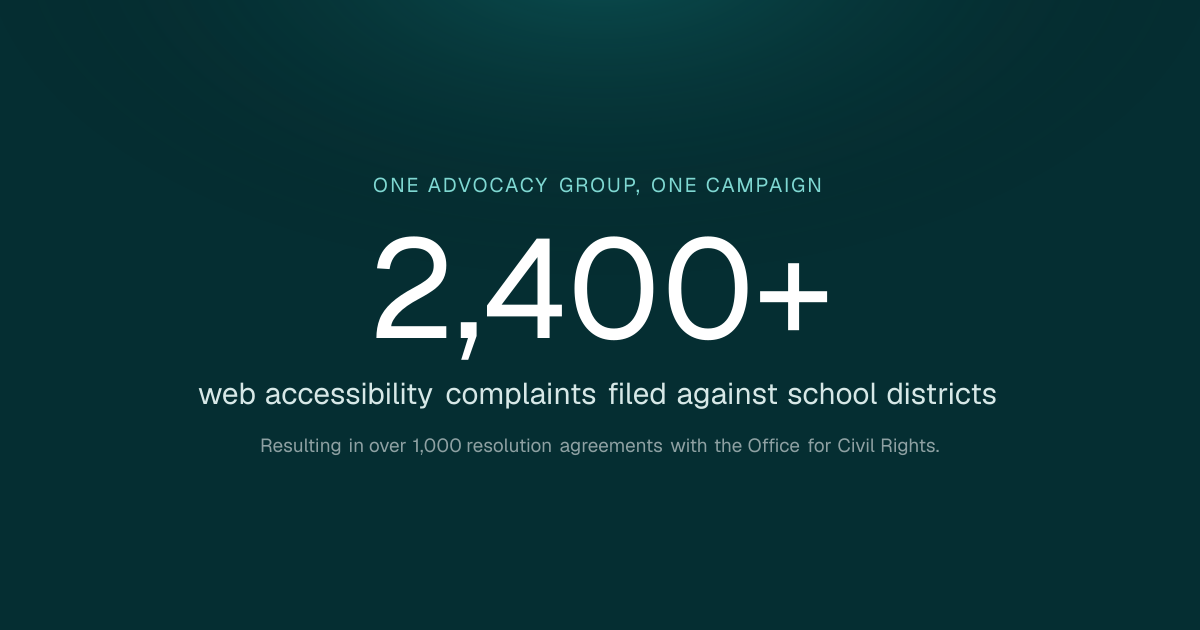
One Advocacy Group Filed 2,400 Accessibility Complaints Against School Districts
Not a lawsuit. Not a class action. One organization, filing complaints one district at a time, and it worked. Over 1,000 of them ended in a signed resolution agreement with federal civil rights investigators.
School district web teams tend to picture ADA enforcement as a lawsuit. A law firm, a plaintiff, a courtroom. That's not what hit over a thousand districts this year. The Michigan Alliance for Special Education ran something closer to a campaign: file a complaint, wait for the Office for Civil Rights to investigate, repeat. 2,400-plus times.
1The Problem: K-12 Sites Didn't Expect to Be a Target
Cities and counties have spent two years hearing about ADA Title II. School districts heard it too, technically, but a lot of district IT teams are one or two people managing dozens of school subsites, a parent portal, a learning management system, and whatever the athletics booster club built in 2019. Accessibility wasn't ignored. It just never made it to the top of a list that's already too long.
Title II applies to public K-12 districtsthe same way it applies to a city hall. Same WCAG 2.1 Level AA standard, same April 2027 or April 2028 deadline depending on population served. A district assuming it's a lower priority target because it's smaller than a city government read the risk backwards.
2The Cause: A Volume Strategy, Not a Targeted One
This wasn't one district with one egregious failure drawing scrutiny. It was a pattern-based campaign. File against district A, get a resolution agreement. File against district B, same five or six WCAG failures show up again. Missing alt text. Unlabeled form fields. PDF board packets with no tag structure. The same mistakes repeat across thousands of districts because most districts built their sites the same way, with the same CMS defaults, the same unreviewed PDF uploads, the same missing alt-text policy.
That repetition is exactly what makes a district an efficient target. An advocacy group doesn't need new evidence for each complaint. It needs the same scan, run against a different domain.
3Who Files 2,400 Complaints, and Why
The Michigan Alliance for Special Education is a federally funded parent training and information center, the kind of organization that exists to help families navigate special education rights, not a law firm chasing settlements. That distinction matters for how districts should read this. There's no payout motive driving the volume. The motive is access, and a complaint to OCR costs the filer essentially nothing beyond the time to document a failure that's usually sitting in plain sight on the public site.
That's the detail that should worry a district more than a plaintiff's firm would. A firm needs a viable damages case to justify its own time. An advocacy group running a parent-support mission just needs the website to still be broken when someone checks it, and checking costs them almost nothing to repeat at scale.
4The Specific Pattern Investigators Keep Finding
A pattern this consistent across a thousand-plus independently run districts points to shared tooling, not shared negligence. Most districts run one of a handful of CMS platforms built for K-12, often purchased district-wide through the same state procurement contract, with the same default templates, the same plugin library, and the same gaps baked into whatever ships out of the box.
That's good news and bad news at once. Bad news: your district's specific CMS vendor may have shipped the exact failure already sitting in a resolution agreement against a district three states over. Good news: the fix is also shared. A platform-level change, not a page-by-page one, closes the gap for every site built on it at the same time.
5What an OCR Resolution Agreement Actually Costs
A resolution agreement isn't a fine, but don't mistake that for cheap. It typically requires a remediation timeline with deadlines, periodic compliance reporting back to OCR, staff training records, and a monitoring period that can run a year or more. For a two-person IT department, that's a second job layered on top of the first one, assigned by a federal agency instead of chosen by the district.
6Life Inside the Monitoring Period
Signing the agreement isn't the end of the story. It's the start of a defined period, often twelve to eighteen months, where the district reports progress back to OCR on a set schedule, usually quarterly. Miss a reporting deadline or fall short of the agreed remediation pace, and the file doesn't quietly close. It escalates, and a district that was cooperating in good faith now looks like one that isn't.
That reporting cadence is exactly why a dated remediation log matters more than a one-time fix. OCR wants to see ongoing progress, not a single sprint before the first report is due, and a district with no system for tracking what's been fixed since the last checkpoint ends up rebuilding that evidence from memory every quarter.
Find the Same Six Failures Before OCR Does
WPPersona's free PDF audit scans your district's first 50 documents and flags exactly the failures that keep showing up in these resolution agreements. No email required.
Run a Free PDF Audit7The Fix: Check the Same Things the Complaints Check
Alt text on every meaningful image
District homepages lean heavily on photos of students and events. Each one needs a description, not a filename.
Labeled form fields across every subsite
Enrollment forms, field trip permission slips, meal applications. Placeholder text alone fails WCAG 1.3.1 and 3.3.2.
Tagged PDF board packets and newsletters
The most common K-12 failure. A scanned agenda with no text layer is invisible to a screen reader, full stop.
A published, current accessibility statement
Every school and department site needs one, with a named contact, not just the main district homepage.
8A Six-Month Plan That Beats Waiting for a Complaint
Month 1: Inventory
Scan every school and department subsite plus the PDF archive. Know the real number before deciding what to fix first.
Months 2-3: Fix the six failures
Alt text, labeled forms, tagged PDFs, and accessibility statements across every subsite, not just the main district site.
Month 4: Train the people who publish
Front office staff, teachers posting to class pages, the athletics booster volunteer. Whoever uploads a PDF needs the five-minute version of this training.
Months 5-6: Put a gate on new content
A scanning step at upload stops the backlog from regrowing the moment this project ends.
Final Takeaway
A two-person IT shop can't out-staff a campaign built on volume. It can out-prepare one. Fix the six failures this campaign already knows how to find, and the next complaint lands on a district that isn't one. For the full compliance picture by population and deadline, see our K-12 accessibility compliance guide, or read how one district cleared its PDF backlog in our K-12 PDF remediation case study.